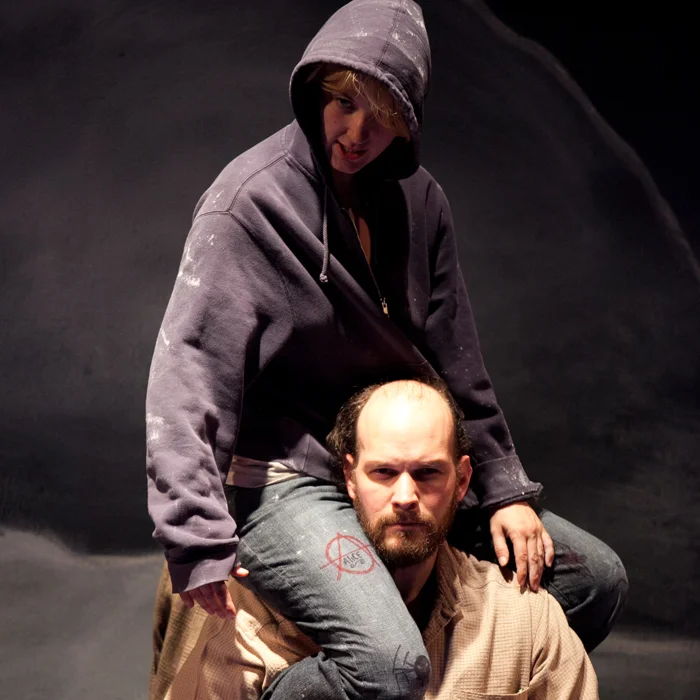
Sophie Gets The Horns
By Adriano Shaplin
Directed by Rebecca Wright
Performed by Kristen Bailey, Drew Friedman, Adriano Shaplin, Mary Tuomanen, Stephanie Viola
Set by Caitlin Lainoff / Lights by Maria Shaplin / Costumes by Katherine Fritz / Sound by Adriano Shaplin
Performed at Incubator Arts Project, May 2012, NYC
“Delicately hilarious…a clear-eyed ethnography of our own species at a specific developmental stage…the ensemble seems exquisitely tuned to a difficult chord of poignancy and awkwardness.” –Time Out
“Absurdly superb…alluring and intense…a supple memory play…Kristen Bailey renders the inner clash between Sophie’s innocence and her attempts to exorcise it with a churning accuracy.” –Backstage Critic’s Pick
“It’s a great piece of black box theater…Anyone who went to college in the pre-9/11 era will appreciate Riot’s delicately self-mocking approach to that twilight of the old era, back when collegiate alienation wasn’t something you posted on your Facebook page…a pop version of the Theater of Cruelty.” –New York Magazine
“Director Rebecca Wright teases out precise, lived-in performances that for the most part maintain a naturalism while fitting into a stylized and fluid production…The drama works here because of the specific and intelligent performances by the committed actresses.” –The New York Times
“Unassailable proof that the Riot Group deserve a wider audience…Mary Tuomanen captures the stage physically, her gymnastics conveying a haunting sense of unpronounceable frustration and loss.” –The Village Voice
“Thoughtful and funny…Nothing has quite captured the decade’s embrace of death and darkness like Sophie Gets the Horns…Alice’s final anthropology project is an explosive climax to this feminist fever dream.” –Flavorpill Editor’s Pick





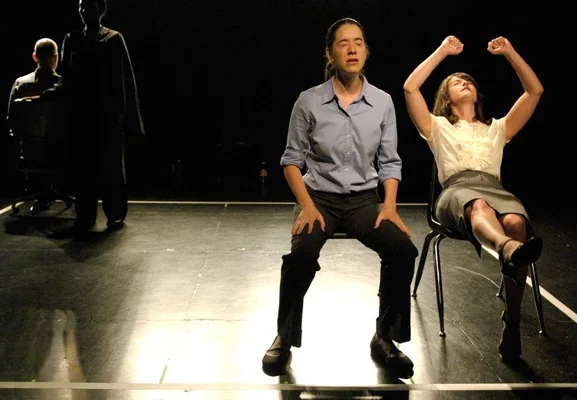
Freedom Club
By Adriano Shaplin
Directed by Whit MacLaughlin
Performed by Drew Friedman, McKenna Kerrigan, Jeb Kreager, Mary McCool, Paul Schnabel, Adriano Shaplin, Stephanie Viola
Lights Maria Shaplin / Costumes Rosemarie McKelvey / Sound Whit MacLaughlin / Projection Design Jorge Cousineau / Production Stage Manager Emily Rea / Executive Producer: New Paradise Laboratories
Freedom Club was made possible with the support of Princeton University, Drexel University, the Off-Center for Dramatic Arts, the Pew Center for Arts & Heritage through the Philadelphia Theatre Initiative, and the National Endowment for the Arts.
“Epic theatre…possessing a unique, violent, and total language, at once written, spoken, and played.” –CultureBot
“In Freedom Club the darker underpinnings of human liberty are considered with a grim cackle.” –The New York Times
“A daring mashup by two experimental companies (Philadelphia’s New Paradise Laboratories and New York’s the Riot Group) and two eras (1865 and 2015), “Freedom Club” indicts fanatical radicalism in America. Aptly self-described as “a hallucination on national themes,” the satire vividly skewers self-aggrandizing extremists from John Wilkes Booth to a feminist collective that spawns another presidential assassin.” -Variety
“Brilliantly eerie, Freedom Club slyly skewers today’s polarized politics.” –Philadelphia City Paper
“John Wilkes Booth [is] played with volcanic intensity by Jeb Kreager…Lincoln looms, top-hat bowed in shame – one of many symbolic images that punches you in the gut…provocative…dizzying… [a] take-no-prisoners political play in perilous times.” –EDGE Philadelphia
“A visual feast…marvelously theatrical…haunting…[a] unique view of history dominated by sex and politics…terrific…a must-see.” –Philadelphia Weekly
“Superb, sexy, scary…a visual pleasure…hilarious…dazzling…a daring mash-up.” –Variety
“Shaplin’s script is sharp, funny and abstract enough to foster a genuine curiosity.” -Philadelphia Inquirer
“The pairing is the thing: Just as FREEDOM CLUB’s two halves play off of each other, in their differences as much as in their similarities, so do the two companies in performance. New Paradise is known for the physical- and image-based nature of its work and process, while the feisty Riot Group is driven by Shaplin’s writing and a minimalist acting style. But both are tightly-knit ensembles driven by experimental approaches, and both have been creating original work for over a decade—oh, and both seem to think John Wilkes Booth is a pretty cool character.” -CultureBot


Hearts of Man
By Adriano Shaplin
Directed by Whit MacLaughlin
Performed by Drew Friedman, Dennis McSorley, Tara V. Perry, Paul Schnabel, Stephanie Viola, Miriam White
Lights by Maria Shaplin
Sound by Adriano Shaplin
Hearts of Man was commissioned by Playwright’s Horizons and created by The Riot Group with the support of the National Performance Network, Flynn Center for the Performing Arts, Swarthmore College and the Philadelphia Live Arts Festival.


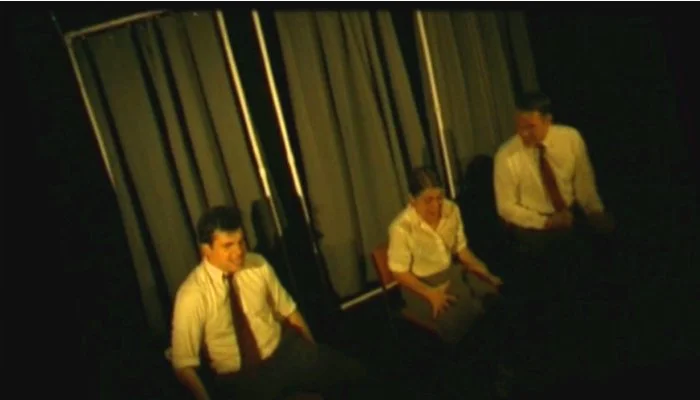
Switch Triptych
By Adriano Shaplin
Directed by The Riot Group
Performed by Drew Friedman, Cassandra Friend, Sarah Sanford, Paul Schnabel, Stephanie Viola
Set by Jim Findlay / Sound by Iver Findlay / Lights by William Cusick
Switch Triptych debuted at the Assembly Rooms in Edinburgh in August 2005 and transferred to the Soho Theatre in January 2006.
"Adriano Shaplin’s plays for his Riot Group company from New York now come with a published text which is a measure of how far they have come since a sharp-eyed reviewer for the Scotsman unearthed them above a garage back in 1998. Just as well, some ongoing practical problems with Shaplin’s own otherwise striking production of his latest play make it quite difficult to hear at times even from the 10th row. Some of these problems arise from the nature of the piece, set in a 19919 New York telephone exchange with overheard dialogue on tinny headphones. Some directorial decisions, such as having the main character facing entirely upstage for a substantial section, do not help. By the time you read this, they may well have been resolved, which would push the rating up a notch.
For on the page, the script looks as sharp and pointed as ever. It is the moments that changes largely, women operated affairs go automatic. Shaplin takes the opportunity to tilt at several issues including women empowering themselves, early trade union activity in the United States (the new trainee turns out to be a union representative) the strengths and weaknesses of immigrant communities and even a whiff of sectarianism.
Still using his characteristic quickfire, layered dialogue where several things are always happening at once, this is nevertheless a big development for Shaplin, a 90-minute period piece with a cast of five, including two outsiders. But core group member Stephanie Viola still catches the eye in the central role of Lucille, an Italian black widow who rules the roost with a cynical but brittle toughness." The Times 8.9.2005
"The clash between spirituality and capitalism is one that lurks equally beneath the neo conservative revivalist right of the United States and its semi-mythic opponents in the Islamic world. But it’s most obvious in the dollar-driven churches of the former. Timely, then, that the splendid Riot Group should make their latest appearance at the Fringe with a piece that interrogates the issue of faith and worldly corruption. It also raises questions about technology and what we unquestioningly call progress which might resonate strongly through our blue-chip age.
Adriano Shaplin’s production of his own play sees five disparate characters at a New York telephone exchange in a deliberately anachronistic 1919. They bicker away, revealing a succession of belief structures and creed to sustain them through the reifying process of a burgeoning corporate economy. The manager (Paul Schnabel) has signed the pledge, and is battling alcoholism on the verge of prohibition. His assistant has signed away his soul for the corporation, and seeks only promotion. Then there are the telephonists, Pippa (Sarah Sanford), a woman simply intent on surviving New York, a new British trainee (Cassandra Friend), who turns out to be dedicated to unionizing the workforce, and at the center of it all, Lucille (Stephanie Viola), a women who has adapted her Italian Catholicism to eccentric purposes in order to incorporate the corruption of her world. All are threatened by redundancy by new technology, and each pursues a strategy of survival in a hostile environment.This gives you the story, but as ever with the Riot Group, it’s really all about the style. Shaplin’s crisply aphoristic text leaps from one profound, complete and witty observation to the next. The strange poetic style of the language creates the perfect distance from which to view the play’s issues, while the insistent, discordant electric piano score punctuates the rhythm like a broken metronome, pushing and pacing the stage action. This, in front of a metallic, cage-like set, is visually very striking, creating tableaux after tableaux, driving us away from naturalism and into other, more lucid, realms of thought.
There are some inaudible lines, a shame for such a strong text, but ultimately, this ingenious piece asks us what we think progress is, and why we feel we need it. It also asks about spirituality in a profoundly self-reflexive world, and queries individualism against collective beliefs. It never preaches, but provokes, and set off by a universally splendid cast, should be a very hot ticket." -The List 10.8.2005
"The Riot Group’s radicalism, by contrast, famously comes in a more overtly political form and house playwright Adriano Shaplin’s latest text for the company is another thrilling and challenging piece of politically driven dramatic poetry set this time in a New York telephone exchange in 1919 in the year when Bell Atlantic began to replace live female operators with an automatic system.
Shaplin uses this early and iconic example of the replacement of human flesh with technology to explore a tense mix of dialogue and monologue how the intense individualism of American culture—dazzlingly represented by the hard-drinking, fast-talking Italian-American chief operator, Lucille—both liberates the human spirit I unique and thrilling ways and desperately limits the capacity to acknowledge the deep vulnerability of human beings, soft flesh, the relative inefficiency and the occasional need for solidarity and help.
Switch Triptych could hardly be more different from The Devil’s Larder in style. It’s both spectacular and static, set on an obliquely lit stage dominated by the rusting metallic presence of three huge old-fashioned telephone exchange machines. It uses heavily amplified sound, not always clearly audible in the terrible acoustic of the Assembly Rooms ballroom, to catch the scratchy intonation of old-fashioned telephone talk and the five-strong company, although their performances are superb in outline, don’t yet seem in total command of Shaplin’s complex text.
But in their defense of the unpredictable, fleshy human being against the advance of machine civilization, these two shows find a strange point of contact. And, as for the objection that these stage figures are more like mouthpieces than characters—well Shaplin is an uncompromising stage poet in the tradition of Ben Jonson and Brecht, rather than Ibsen and Chekov and, in any healthy theatre culture, that’s allowed." -The Scotsman 11.8.2005


Pugilist Specialist
By Adriano Shaplin
Directed by The Riot Group
Performed by Stephanie Viola, Adriano Shaplin, Drew Friedman, Paul Schnabel
Lights by Maria Shaplin / Sound by Adriano Shaplin
Pugilist Specialist, a Riot Group/Chantal Arts Ltd. co-production premiered at the Pleasance Theatre, Edinburgh, on August 1, 2003 and subsequently opened at the Soho Theatre, London, on January 11, 2004. The London engagement was extended at the Riverside Studios. This production opened in New York on September 13, 2004 at the 59E59 Theater and subsequently extended its run at the Culture Project @ 45 Bleecker St.
Pugilist Specialist received the Scotsman First of the Firsts Award and the Herald Angel award at the Edinburgh Fringe Festival 2004. Pugilist Specialist received the Bay Area Circle Critics Award for Best Touring Production.
"Pugilist Specialist is this year's brilliant offering from the hard-hitting American ensemble The Riot Group, fast emerging as leading Fringe critics of their country's culture and policy as it embarks on a new phase of history as the world's only superpower.
Writer Adriano Shaplin and his team - Stephanie Viola, Paul Schnabel and Drew Friedman - avoid the pitfalls of predictable anti-war grandstanding by going straight into the belly of the beast, and trying to understand the splits and conflicts that are bound to emerge among the American military and the political right as the country becomes ever more deeply drawn into its role as global policeman and de facto imperial power.
The situation is stark; somewhere in America, an elite group of marines assemble for briefing on a covert operation to assassinate a Middle Eastern leader.
There's an ageing post-liberal colonel, a slightly crazed sniper called Freud, an uptight military archivist and propaganda man called Stutter, and a fiercely talented and single-minded female lieutenant, Emma Stein, who is known to have made a public complaint about certain abuses she suffered during her time at an army training base. And through 70 minutes of breathtakingly fast and penetrating dialogue among these four characters, backed by a quiet, rhythmic soundtrack of mounting complexity and intensity, Shaplin mounts a searing analysis of the gulf that is opening up between imperial idealists like Emma Stein who believe in the values and principles embodied in the US Constitution, and in a national mission to create a global society that reflects those principles and old-fashioned military men used to a culture of legitimized brutality, unthinking obedience, and cynical self-interest.
Here, it's the idealist who proves the loser. But whatever we make of its desperately tense final moments, Pugilist Specialist emerges as perhaps the most truly grown-up piece of theatre on this year's Fringe; a show that spares itself the effort of dumbing down or sexing up, and simply cuts straight to the dark, complex and often bitterly comic heart of the new global politics that is shaping our future, whether we like it or not." -Scotsman. 8.5.2003
"It's a military operation. A trio of cameo-ed up grunts, trained to kill are cherry-picked for a mission impossible. The operation? To assassinate a mustachioed Arabic despot -The Bearded Lady- and liberate the free world as we know it.
One's just following orders, another's laughing his way through the fear, while the other, the most capable of all, is a GI Jane with much to prove, and who can mix it up with the best of them without any need for sexual favours. In the end, however, orders are orders, and in the dirtiest war of all, it seems every one's expendable.
There's something exceedingly pure about the Riot Group's work. Almost zen-like in their stylistic simplicity, the well drilled quartet stays pretty much stock still throughout, yet conjure up a battlefield of institutionalized aggression that moves from the mess hall to the field with only the twitchiest of leaps.
Here, as they spar with a barrage of machine-gun exchanges that punchline each scene, they're still as focused as in previous years, but significantly less hectic.
Consequently, the purity of their aesthetic is allowed to breathe, conspiring to make them an even more dangerous proposition. Adriano Shaplin's script is a wordy trawl through the undergrowth of emotions smoke-screened by the very notion of a just war. Its language is culled from press conferences and po-faced secret-agent shows, and is played so straight as to heighten the situation's life-or-death absurdity.
As the lone woman in the troop, Stephanie Viola is no Private Benjamin, but a steely agent provocateur caught in the crossfire of a chain of command at odds with itself.
It's a brilliant progression for the Riot Group, who need to ensure that their shtick doesn't become stale or formulaic. Their biggest achievement here is the use of events in Iraq as source material for something genuinely, creatively, and brilliantly provocative without ever beating the audience about the head with it. If you're looking for collateral damage, go tell it to the marines." -Glasgow Herald. 8.5.2003
"The Riot Group deploys irony like a weapon of mass destruction, ripping with ease through the sentimentality and carefully constructed illusions inherent in political language. Last year, this furious and devastatingly funny theatre company reworked King Lear for a CNN-style newsroom, now they return as steely-souled marines, on a mission to assassinate a Middle Eastern dictator with a moustache and a country full of look-alikes.
Writer Adriano Shaplin punctuates savage observation with quasi-Shakespearean riffs on any subject from the idea of war fought by babies (because they're cold-blooded and fearless) to the true value of the hot-dog. The cast's deadpan delivery, accompanied throughout by a shifting ambient beat, gives added punch to the desert-dry humor of such lines as: "If at first you don't succeed... redefine success", or "Victory forgives dishonesty".
Two benches run across an otherwise bare stage, for a production which shifts between the headquarters where the assassination is planned, and the scene of the assassination attempt. Dressed in camouflage, the four members of the San Francisco company trade phrases, toying with concepts of poisoned diplomacy and bloodlust-- whether it's Paul Schnabel's 51-year-old colonel grimly informing his pretty and flinty ambitious female lieutenant (Stephanie Viola) that he objects to a "world too weak to see you in a body bag", or Lieutenant Freud (Shaplin) asking: "Can you feel how much sense the world makes?" as he gets off on the excitement of having shot his ammunition.
Incredibly, Shaplin is only 24. If he and his brazenly intelligent group continue to evolve with such poise and originality (what other company could pull off a joke about Saddam's seductive eyes and the problems of infra-red goggle?) the theatre world will be a better if more cynical place. At the show's shocking end, the cast received a standing ovation from the front row - a fitting tribute to their lethal linguistic fireworks." -Evening Standard. 8.5.2003
"Somewhere in America, a political assassination is being planned. The target is an Arab leader with a very big moustache. The participants are a hand-picked trio lead by a fatherly, once-liberal colonel. There is an uptight communications expert keen on following orders and a full-of-himself sniper.
There is a final member of the party, Jessica Stein, a sharply intelligent and successful explosives expert who has become a thorn in the military's side since she made a complaint about harassment and was splashed all over the front of the New York Times. Still, this woman is a professional ("success is my feminism") and she'll get the job done.
The Riot Group has been cutting a swathe through Edinburgh in recent years with its portraits of an America in crisis, and it hits the bull's-eye with this stylish and intelligent reflection on the moral conundrums that open up when you start trying to play policeman to the entire world. A real piece of tense, hard theatre about the tense, hard realities of the times we live through." -Guardian. 8.6.2004
"This engrossing piece of theatre is likely to be the best thing you see this festival. The Riot Group's latest foray into political theatre and the politics of theatre sees four US Marines preparing a black operation involving the assassination of a Middle Eastern leader. A zealous female meritocrat, a psychopathic sniper, an emotionally dead technician and a sinister commanding officer combine to provide a searching examination of American military expansionism as you could find.
A simple, compelling score sets off the rich incantations and aphorisms of Adriano Shaplin's script, which takes us on a rich journey through rhythmic repetition and startling turns of phrase. There is an exploration of neo-conservative ideology that uncovers, in its minions, and through, by implication, to its leaders a sub-erotic relationship of America to the enemies it finds to propagate paranoia.
Meanwhile, the role of history, gender relations and philosophy in all is elucidated. If that sounds pretentious, then I should add that this piece is as funny as anything you'll see. One particular sequence, where the squaddies read aloud letters sent to them by American children, is a highlight among many. Just see it." -The List. 8.7.2003
"It's shaping up to be a festival of serious intent. None of your whimsical relationship dramas here-- it's all tough plays on big political themes. Which makes the Riot Group, from San Francisco, look all the more at home. The company blasted through the complacency of recent festivals with their award-winning Wreck the Airline Barrier and Victory at the Dirt Palace, and now it's back with a ferocious look at the American military and its obsession with taking control of the Middle East.
Young writer and director Adriano Shaplin treats his actors and his language with the same rigour. He writes in a dense, fiercely intelligent barrage of words, while his actors perform with a tightly drilled muscularity. It's a style that demands close concentration, as they portray an undercover marine corps on a cold-blooded mission to take out an Arab leader.
Their brutal world-view is brilliantly satirized, for example when they receive a batch of politically subversive letters from American schoolchildren, and though sometimes Shaplin can seem too clever for his own good, there's no denying the power of this invigorating company." -Independent. 8.8.2003
"The bloody, sometimes farcical events in Afghanistan and Iraq are the most compelling stories of our times, and every other stand-up comic has a routine about the absence of weapons of mass destruction. But it might seem premature for distinguished dramatic writing on this topic to have emerged Yet Pugilist Specialist, by the remarkable 24-year-old American playwright Adriano Shaplin, is exactly that - a riveting drama posing thoughtful questions about the war against terrorism.
The cast comprises Shaplin and three other members of the San Francisco theatre collective the Riot Group. They play four US Marines on a clandestine mission to eliminate a hostile Middle Eastern political leader, nicknamed "Big 'Tache". They're an intriguing quartet: the wisecracking sniper Lt Freud (Shaplin); a paternal, ex-liberal colonel; Harpo, an uptight, secretive communications/propaganda man; and Emma Stein (Stephanie Viola), a single-minded explosives expert, distrusted by the military since she complained about sexual harassment and made the New York Times front page. Together they plan, attempt and botch the assassination.
Shaplin's characters talk in stylized cadences, delivered at quickfire pace. "I eat unconscious desires for breakfast," quips Freud. "I know where loose talk goes to die," Harpo protests. "There's a reason peace and quiet are partners." Each character typifies a certain attitude towards the war on terror and the moral ambiguity of murder in pursuit of a possible greater good. In exploring these conundrums, Shaplin has created dazzling theatre. It's hard to imagine more brilliant or arresting new writing being uncovered in Edinburgh this year." -Daily Telegraph. 8.11.2003
"It is the comedians rather than the tragedians who seem to have most to say this year about weapons of mass destruction and the dangers of international terrorism. Perhaps events have been moving too fast for even the most agile theatre group. But these two plays suggest there is fire in the belly of at least two writers--one American the other Australian.
Those walking out probably wouldn't like Pugilist Specialist, the latest from Adriano Shaplin's four-person Riot Group, much either. The US group has developed a particular non-naturalistic, declamatory style. This year Shaplin turns his caustic wit on the inside of the US military machine, Special Forces, black ops.
An operation to take out a Middle Eastern leader with a moustache (no, no prizes at all) is being planned by an elite unit. But it turns out that even the middle of the machine is rotten with corrupted values, spin and politics, and in a sickening cynical twist at the end, a whole new kind of friendly fire.
Although the Riot Group uses only a couple of benches and a throbbing soundtrack by way of setting, this marks a step forward in its work. There is more individual characterization, a more complex narrative arc and a more subtle build-up of tension. Above all there is more confidence in Shaplin's writing, somewhere between David Mamet and the late Bill Hicks He tends to give himself the best lines--goodness knows, there are enough to go round-- but this, too, is exhilarating theatre." -London Times. 8.13.2003
"Edinburgh wouldn't be Edinburgh without another hit production from the Riot Group, whose Victory at the Dirt Palace made it to London last year. With Pugilist Specialist, writer/director Adriano Shaplin has let a little air into the company's rarefied house style. This new production zeroes in on a US military mission to assassinate an unnamed Arab leader. As the assassins bicker and the plans evolve, Shaplin exposes the moral (and logical) unsustainability of America's self-commissioned campaign to rid the world of evil.
As with Dirt Palace, Shaplin's characters speak in clipped, impossibly smart epigrams. But he's learning to let humanity, and drama, in on the equation. The party's eventual mission to nobble so-called Big 'Stache is a masterpiece of tension that brilliantly unites Shaplin's love/war metaphor. The army exists to provide the weak with comfort: 'can you feel how much sense the world is making all of a sudden?' asks Freud, as his finger tightens on a trigger.
Imagination is gratuitous. 'I'd rather be alive and ignorant,' says Shaplin's colonel, 'then dead and sensitive to the facts.' A vivid and timely play." Time Out London. 8.13.2003


Victory at the Dirt Palace
by Adriano Shaplin
Directed by The Riot Group
Performed by Paul Schnabel, Stephanie Viola, Drew Friedman, Adriano Shaplin
Sound by Adriano Shaplin / Lights Maria Shaplin
Performed at La Val’s Subterranean Theatre, The Garage Theatre Edinburgh Fringe Festival, Riverside Studios, The Cambridge Drama Centre, Contact Theatre, The Helix, The Arches, Flynn Center for the Arts.
In 2008 Victory at the Dirt Palace was revived at the Ice Factory Festival in a production directed by Whit McLaughlin.
Victory at the Dirt Palace was created with the support of the University of California Institute for Research in the Arts and was produced in London by Riverside Studios and Chantal Arts Ltd.
REVIEWS:
“For at least a century, the media have been known as the Fourth Estate, one of the great powers in the realm; but still, when theatre companies look for a new take on Shakespeare's great political tragedies, they tend to set them around governments and rulers rather than newsrooms and editors.
Until now, that is. The fast, loud and brilliant Riot Group, of New York, return to the Garage this year with a blistering show loosely based on the father-daughter conflict of Shakespeare's King Lear (the programme informs us that the play contains exactly 103 words borrowed from Shakespeare) and is set in the television news studios of two competing United States networks on the night of an 11 September-style attack.
The father, fronting the news for one network, is ageing liberal journalist James Mann, "the most trusted man in America". The daughter, K Mann, has just been promoted to news anchor for the opposition.
Together with their two sidekick producers -- including K Mann's bullying and bullied husband Spence, who is partial to a spot of sexual strangulation to get his adrenaline flowing before the show goes on air -- they run the gamut of ruthless and exploitative media attitudes to the human tragedy that is the news.
Both are driven by the insane levels of competitiveness and aggression that pass for normal in the media, but K Mann -- Regan, Goneril and Cordelia rolled into one Ð outstrips her father for sheer hungry ambition and quickness in grasping that patriotic bullshit has become the order of the day.
There's a sense that having set up the situation, Adriano Shaplin's script doesn't quite know what to do with it, veering from the surreal to the grotesque; and this big, loud show is absurdly cramped and confined in the tiny Garage Studio.
But Paul Schnabel and Stephanie Viola give terrific, red-hot, flawless performances as father and daughter, with Shaplin and Drew Friedman in support, and it's refreshing to see at least one company on the Fringe that, instead of sitting around whining about the unaccountable power of the media, stands up and gives the whole arrogant industry a smack in the mouth.” -Joyce McMillan, The Scotsman, August 2002
“High flying newsreader Kay likes to be in control - of everything. Of sex, her career, her twisted family life. "I don't have any taste. Just appetite," she bites, before asphyxiating her assistant with a plastic tube for horny kicks. Kay is in constant battle mode. She struggles for supremacy on the networks, for power over her father (a legendary TV news anchor on a rival channel) and, crucially, against the accusation that she's getting more like him every day. "He doesn't love me," she spits. "He loves me like cancer loves cells."
Though loosely based around King Lear, Victory at the Dirt Palace is so much more than a simple modernisation. A biting, kicking, screaming attack on modern broadcast journalism, it is ankles, knees, belly, head and shoulders above any other adaptation of anything you will see at this year's Fringe. The script, the production, the acting are all astonishingly, mindblowingly, headfuckingly awesome. "If a story grabs me, it needs to leave a handprint," says Kay, rejecting a news item she sees as too tame. How apt. This will leave permanent scars.
thrill: Acidic wit that kicks where it hurts.
spill: Almost too terrifyingly perceptive.” -Helen Pidd, Fest, August 23 2002
“Adriano Shaplin; remember that name. Three years ago Mr. Shaplin, then an undergraduate at a liberal arts college in upstate New York, formed a company called the Riot Group and brought his play Wreck the Airline Barrier to Edinburgh. It was a visceral assault on American capitalism, performed in an out-front, aggressive style that suited the material perfectly.
As writer, director, and one of the performers, Mr. Shaplin collected a brace of awards to take back to the college whose drama department had more or less turned its back on him because it thought he was too weird.
Now he is a postgraduate at Berkeley and his Riot Group is back with another firecracker of a play, this time about the American news media which, with faint echoes of King Lear, has a father and daughter competing for ratings as anchors on competing nightly news programmes.
Meanwhile, across Edinburgh, a group of recent graduates from Oxford have restaged his first play, adapting it slightly to this side of the Atlantic.
The new production of Wreck the Airline Barrier is quite different from the original, played en traverso rather than front-on, less aggressively, though still at top speed, with well spoken English accents finding more nuances in the lines than Shaplin's original version. I liked Simon Wood's version less than the original but that may be just sentiment and it is still a decent piece of work. More importantly the play holds up very well on second viewing.
Victory at the Dirt Palace reprises the machinegun delivery, inch-perfect timing and simple but highly polished production style of Shaplin's earlier production. The play benefits from concentrating on a more tightly focused subject and scores several bulls-eyes on the bizarre exploits behind the scenes of television news. Not all of them are original but the scenario of a massive national catastrophe breaking into the usual slick cliches is and the ensuing meltdown is and the consequences are certainly dramatic.
Stephanie Viola, who plays Kay Mann, the daughter, has a way of remaining entirely still and focused in the mayhem that is going on around her which is a joy to watch.
It would be good to see Shaplin graduate to larger stages with more facilities. It is undoubtedly easier to create the claustrophobic intensity he is becoming known for in a sweaty loft that it is on a large stage. Perhaps someone like the Traverse, which has links with many North American companies, should be talking to him about his future plans.” -Robert Dawson Scott, The Times, August 19 2002
“It's rare that one sits in the theatre and experiences something truly brilliant, but such is the case with the Riot Group's latest offering. As is often the case, however, it is not altogether easy to pinpoint exactly what it is that makes this such an exciting piece of work.
Superficially, Victory at the Dirt Palace is a comment on the media told through the relationship between father and daughter news anchors working for rival US networks. It also plays with the same relationship, and the descent into madness, of King Lear. But it is much more than this.
Father and daughter both suffer from "object permanence disorder", an inability to differentiate their own experience of the object world from the experiences of other people; presented with new information these characters are unable to remember how they saw things before, or to conceptualise how other people would view things in the absence of such new information. Thus, on the superficial level, object permanence disorder comments upon the vacuous nature of the news media for whom every event is a new event, every disaster is the worst disaster that has ever happened; in the struggle for novelty and ratings, a sense of history and perspective is missing.
Yet on a more profound level, the notion of object permanence disorder seems to hint at the elision of the inner and outer world, the confusion of private psyche and public consciousness, that pervades contemporary society. This is a theme that Adriano Shaplin, the Riot Group's writer, director and actor, has played with before. In the 1999 Fringe First winning Wreck the Airline Barrier, Shaplin put representatives of white corporate America together on an aeroplane and envisaged what would happen if they failed to distinguish their private thoughts and prejudices from their public statements.
The result was an anarchic outpouring of racist and sexist perversity. Victory uses a similar device to an altogether more intellectually sophisticated end: in the modern world, it asks, where is the line between the news told in the media and the reality of the world it comments upon. The question becomes all the more urgent when the attacks of 9/11 are introduced as nothing more than the backdrop to a 24 hour ratings war.
The idea of the war against terrorism as a construct for national media and domestic policy is raised here in a disturbingly astute way. But this is not a work of politics masquerading as theatre. At the heart of Victory is an attempt to unsettle the audience's sense of security and meaning. The dialogue is performed at a lightening pace that is as exhausting for the audience as it must be for the players.
The latter are clearly so familiar with the piece and with each other that at no point do they appear to be acting: they deliver their lines as if from instinct, and the result is that one is barely given enough time to breathe, let alone to reflect upon what is going on before you.
Combine all this with the claustrophobic atmosphere - I rather had the impression I was watching a piece of theatre performed in the confines of a submarine at war - and the sheer intensity of the performance - as one member of the audience put it, the piece begins at gas mark 10 and remarkably manages to reach gas mark 12 after 75 minutes - and you are left with a piece of theatre that you know you need to watch again and again, and that you will have a different though equally disturbing experience each time.
This is a piece of work that will stay with you for a long time.” -James Panton, Culture Wars, August 2002
“For its fourth Fringe visit, the Riot Group weds a fiercely funny critique of the news media to a contemporary riff on King Lear. The protagonists are a pair of rival news network anchors locked in a ratings battle. They also happen to be father and daughter linked, says writer-director Adriano Shaplin, by a common disability. "Both lack object permanence: the understanding that objects/people which are out of sight still exist. This functions as a metaphor for journalistic amnesia, while their relationship explores gender, sexuality, power and the language of patriarchy."
The Rioteers' commitment to words supersedes the need for movement. "As performers we're inspired by newscasters, preachers, politicians, motivational speakers and boxing ring announcers," Shaplin explains. "We like official speech; it's a very particular type of perverse poetry. And we prefer sitting and standing." In Victory the actors are stuck behind desks. "I direct them to behave like animals in cages, forced to growl and pace back and forth in order to express themselves."
Victory isn't the sole evidence of the Riot Group on the Fringe. A student company from Oxford is tackling Wreck the Airline Barrier, the award-winning script that put the Rioteers on the map back in 1999. "We generally don't like cover bands," Shaplin says, "but we also thought it would be interesting to see how that piece would be received outside its original context." -Donald Hutera, The List, August 1 2002
“Any politician who has been on the barbecuing end of Jeremy Paxman's questions will have little doubt about who wields the most power; so it seems apposite that this bitingly avant-garde reworking of King Leargives royal status to two high-profile news journalists.
The Riot Group's razor-sharp satire on American news reporting shows how the ageing news anchor James Mann is ruthlessly upstaged on a competing channel by his daughter, K Mann, in a linguistically lethal and excoriatingly witty fight for media supremacy.
In the tiny, sweaty theatre at the Garage venue, the play's urgently beating pulse is emphasised by a relentless drum beat. There is no room for soft emotion here: K declares that her father loves her "like cancer loves cells", while James remember her as "a 10-year-old-gluey". When an 11 September-style attack takes place, both are naked in their attempts to combine sensationalism and nationalistic sentimentality in order to win the greatest viewing statistics.
Stephanie Viola excels in portraying a woman so hard, she could make flint look cuddly. Her struggle for success fizzles with the Freudian desire to attain supremacy over her father; although as Goneril, Regan, and Cordelia all rolled into one, her cruelty is undercut by a reluctant tenderness when she realizes the depth of the wounds she has inflicted.
The verbally pacey drama also derives considerable spice from both news anchors' relationships with their producers. K's husband and wannabe-mentor Spence enjoys indulging in a little light S&M; before they go on air, while Andrew craves James's job, boasting malignantly "I'm the son he never had".
It is ironic that while several productions at this year's festival struggle to respond to 11 September, this cynical, angry production seems the most emotionally honest. By mercilessy attacking language's fickleness at such a time, it allows the tragedy's unspeakable horrors to stand tall.” -Rachel Halliburn, This is London, August 2002


Wreck the Airline Barrier
By Adriano Shaplin
Directed by The Riot Group
Performed by Drew Friedman, Adriano Shaplin, Stephanie Viola
Sound by Adriano Shaplin
Wreck the Airline Barrier premiered at the Edinburgh Fringe Festival in 1999 and was published by Oberon Books in 2004.
REVIEWS:
“A fantastically well crafted cauldron of dramatic chaos, the aptly named Riot Group's Wreck the Airline Barrier is possibly the most visceral, disturbing and cerebral piece of theatre you will see on the Fringe this year.
Set on board a troubled passenger flight, this work should finally kill the joke about the lecturer who went to the United States to teach irony as a second language. These young Americans have created an inspired, sinister satire of modern society, a bizarre cross-breed of Franz Kafka and Lenny Bruce. The play positively drips with fear, hatred, self-loathing and alienation.
If that sounds like an emotional rollercoaster ride, that is because it is. The labyrinthine script of glass-sharp fragments of language and the violently unleashed performances are simply incendiary.
You can sit back, but I defy you to make yourself comfortable as the Riot Group provides you with your "emergency entertainment". For first-class passengers there is, in addition to sexual favours from the cabin crew, a short talk on the social detritus responsible for the moral degradation that is "Mercedes-Benz defacement". Lesser human beings must make do with the in-flight magazines which might just change their world view. Combined with casual Hitler admiration, latent white supremacism and super-Freudian sexual anxieties, we have well and truly arrived in the realm of the very darkest humour.
The central characters, although they function more as the discordant vehicles of the abstract plays of Gertrude Stein than as personalities, are described as "motivational speakers", but you will be too disquieted by what is motivating them to care what that means. This is genuinely avant-garde theatre, a modern stage equivalent of Luis Bunuel and Salvador Dail's film Un Chien Andalou, a metaphorical razor across your dramatic eye.
The performers and writer prefer to remain anonymous. This, like so much else in the work, ties their extraordinary live art to the experimental theatre of the Twenties and Thirties; I almost expected to be handed a Futurist manifesto as I left.
As should be clear by now, this play will be simply too weird and too explosive (you might be hit by a flying expletive) for some. An acquired taste it may be, but Wreck the Airline Barrier is one of the most excoriating plays this critic has seen in a long time, truly an exhilarating and terrifying powerhouse of dramatic inventiveness. - Mark Brown, The Scotsman, August 17 1999
“For those who missed out on this week's installment of experimental theater, one of the best productions passed through Burlington en route to Scotland's Fringe Festival. The Riot Group's Wreck the Airline Barrier proved a cleverly written, well-concieved, expertly performed, and all-around tasty bit of biting social satire.
Three actors squeezed onto the Rhombus Gallery's itsy stage and delivered a performance so over the top and loaded with criticism of American socicty that many audience members felt as though they had been run over hy a Mack truck. Questions of rage, civil unrest, honesty, and sexuality riddled a script so profane that it made Bad Lieutenant look like the Teletubbies. With skilled syncopation and near-constant eye contact with the audience, the cast produced a bitterly uncomfortable mix of tension and anticipation.
The premise was this: three motivational speakers get on a flight to Spain accompanied by a mentally unstable airline staff and a cabin crammed with angst, fear, and sideshow-quality debauchery. Over the course of the doomed flight, the audience witnesses the passengers shift from confident, positive affimiation-spewing jabberers to screeching, retching, downright ugly shreds of themselves evoking the lowest common denominators of society. Adolph Hitler is discussed as a hero because, although he did commit genocide, at least he believed in something. When one character describes getting soap in her eyes, she tells herself "At Ieast I'm not in a concentration camp" and the pain goes away. The recurring mantra of "Salvon" originates as a calming cooing Amen-like synonym for all things holy, but erodes into childish blathering as the plane experiences hydraulic failure. Bulimia is portrayed as a badge of courage. The defacement of the Mercedez-Benz is considered a crime of horrific proportions.
Stephanie Viola, as "Sarah", delivers a fire-eating performance whether hurling obscenely nasty profanities at the audience or interpreting her son's spooky incest-suggesting poem "Mommy Loves My". She shifts brilliantly between the role of passenger and the unbearably perky stewardess who longs for her flying talking teddy bear. Drew Friedman portrays "Steve", a husband and father hellbent on committing adultery because he believes his wife won't mind. His turn as the high-volume pilot blasts such energy that one wonders if crystal meth has made inroads in Burlington. Playwright Adriano Shaplin, as "Stone," seethes with raw fury as he evolves from airplane-phobic to sexual monster busy assaulting a fellow passenger. Whether vomiting due to the mention of the word "tampon" or obsessively combing his hair or fantasizing about sticking his tongue in a 14 year-old's ear, Shaplins performance goes full throttle without exploding messily.
Shaplin's vision for Wreck the Airline Barrier represents something Burlington doesn't see much of: true raw experimental theater. When first performed at Sarah Lawrence College, the play caused threats of expulsion to be cast on the actors. It's no wonder sensitive folks jumped to conclusions (the play contains a segment where all three actors jump to their feet and vehemently Sieg Heil), but Wreck the Airline Barrier is hardly a piece of inflammatory shock theater. Shaplin and his cast have sculpted a sophisticated study of the roots of racism, sexism, capitalism, and social injustice, revealing the hypocrisy between what people think and what they say. The Riot Group is the most promising experimental troupe the Queen City has witnessed in years, even though they all deserve a good spanking. Salvon.” - Cathleen P. Warren, Vox, August 8 1999
“The first attempt at reviewing this show was foiled by multiple technical failures and collapsing scenery, earning the company a Herald Devil. At the second attempt there weren't enough chairs.
Squatting on the floor in the oppressive heat of an airless Fringe venue could put many a reviewer in a less than kindly mood, but this show is so stunning all is quickly forgiven.
The three young actors of New York company The Riot Group deliver absurd stream of-consciousness-style speeches like true heirs of David Mamet and Sam Shepard. Their timing is perfect, voices clear as bells.
The story is of a plane crash, the script revolving around the concept of "Salvon", half self-help method, half brand name. It's also the name of the airline they're flying on, and the surname of all three characters, who damn themselves regularly through their plastic smiles with fascist lapses.
The over-riding theme is that the world is not a safe place, it just pretends to be, and that fear is at the root of half of society's problems. As the pilot says: "If you hadn't been so scared we might not have crashed." It's genuinely frightening. A thrilling piece of theatre.” - Stephanie Noblett, The Herald, August 1999
Steve, Stone, and Sarah are three peppy Americans who meet each other, and their fate, on a passenger flight to Spain. They each say goodnight to their kids on their mobile phones as they drive to the airport, share their fears of flying while waiting in the departure lounge, then board their flight (where the meal choices are "chicken or egg"). Later on, the plane will crash.
This is a bizarre, intense, and very funny play about America, motivational speaking, religion, mindless optimism and suburban fascism. On a minimal set in a tiny venue, three actors, dressed like Mormon door-knockers, bombard the audience with self-help cliches, new-age drivel and far-right apologism, voices interweaving like soloists playing a triple concerto.
The cast attack the script with an almost worrying seriousness, unsmiling through all the vicious irony and absurd humour (typical line: "The Hitler inside you is hurting, Steve. Did I ever tell you that?"), and by the end, they have degenerated into full-throated swearing, shouting and sweating - just the sort ofthing that gives fringe theatre a bad name. But their sheer conviction pulls the audience right inside their nightmare; you don'tjust witness a descent into pre-crash terror and hatred, you are part of it.
I came out deafened, dazed and confused. Dazzling. -Adam Dudding, The List, August 1999


Why I Want to Shoot the President
By Adriano Shaplin
Directed by The Riot Group
Performed by Stephanie Viola, Jenna Friedenberg, Andrew Friedman, Adriano Shaplin
First performed at Sarah Lawrence College. Debuted at the Edinburgh Fringe Festival 1998.
"In 1981, John Hinkley Jr. shot Ronald Reagan for the love of Jodie Foster. Every U.S. President elected in a year ending in zero has died in office. The number of letters in Ronald Wilson Reagan's name is 6-6-6. Make of all of that what you will. The Riot Group make it something very good indeed.
The show interweaves Hinkley's poetry with psychological invention, wide-eyed media parody and punk rock rage until its net takes in not just this one obsessive but the whole premillennial United States landscape.
Fame, apocalyptic religion and television are considered and confused until the American Dream and its most extreme, seemingly antithetical elements are exposed as inextricably linked.
Apart from a few violent outbursts, the four actors are static, producing a ceaseless flow of confession, commentary and questioning, a dazzling polyphony that fluctuates between harmony and discord. In theatre, there is little to compare it to, but imagine a collaboration between Allen Ginsberg, Hal Hartley and Chris Morris and you're getting close.
It's a long, hard 90 minutes in a hot little room. Definitely not for the fainthearted, but as a piece of experimental theatre, it is stimulating and cerebral and as a performance truly breathtaking." -Scotsman 8.17.1998
"Those crazy Americans are so touchy. The Riot Group were forced to alter their work about John Hinckley's assassination attempt of 1981 from Why I Want To Shoot Ronald Reagan Luckily, the spirit remains in this piece dealing with the difficulty of language, media manipulation, the power of advertising and what happens when people don't fit in to the recommended course of society.
The four players give edgily impressive performances as the tale swings back and forth from the apocalyptic millennium. Uncomfortable and at times disturbing, Why I Want To Shoot the President is ultimately greatly rewarding." The List. 8.20.1998